- Why a separate step?
- Recommended EDW update chain
- Workflow action: Harvest source metadata
- What is stored
- Applying harvest to the catalog and source models
- Efficiency
- Catalog is never rewritten by harvest alone
- Relationship to the schema gate
- Exploring harvest history (GUI)
- Model check reuse (Phase 4)
- Phase roadmap
- Related documentation
Metadata harvesting is a first-class operational step that discovers live source schemas, compares them to the catalog (or a catalog version tag), and persists snapshots and drift history — without loading the EDW and without rewriting the working catalog.
Harvest is not a greenfield first step. It needs a resource definition group whose models already reference catalog sources. To start a warehouse, publish from a source model first — Getting started — building an EDW. Generate .hsm from harvest… is a day-2 discovery path after you have already loaded (or at least modeled) those sources.
This is separate from:
-
Resource definition validation (schema gate / policy)
-
Data quality measure (row content rules)
-
Catalog versions (design-time frozen contracts)
-
DV/BV/DM update actions (load)
[Issue #112](https://github.com/ProjectDataHopper/hopper-edw/issues/112) motivates treating “what do the sources look like now?” as its own wave in an EDW update.
Why a separate step?
Concern |
Without harvest |
With harvest |
When is live metadata read? |
Inside validate / model check / load |
Explicit Harvest source metadata action |
History over time? |
Ephemeral reports only |
OPS tables ( |
Efficiency at scale |
One discovery per record definition |
Connection-batched discovery (one JDBC session per source database) |
Detect drift without models? |
Tied to validation axes |
Harvest alone is enough to record and review drift |
Catalog rewritten? |
Only via explicit refresh/remediation |
Never by harvest |
Recommended EDW update chain
Harvest source metadata          ← observation (this page)
  → Validate resource definitions  (schema gate / policy)
  → Measure / Evaluate source quality
  → Update resource definition group
  → (optional) Measure target quality ALERT_ONLY
Harvest observes. The schema gate decides whether drift should fail the workflow. Quality measures content. Update loads.
Workflow action: Harvest source metadata
Category General. Plugin id HARVEST_SOURCE_METADATA.
Selection and baseline
Option |
Description |
Resource definition group |
Required. All catalog sources referenced by the group’s DV/BV/DM models are harvested. |
Data catalog connection |
Optional override; empty uses group/model defaults. |
Expected baseline |
|
Baseline catalog version |
Tag when baseline is a version. |
Record source group filter |
Optional |
Source database filter |
Optional Hop connection name; only DATABASE feeds on that connection. |
History (OPS)
Option |
Description |
Persist harvest history |
Default on. Writes durable rows. |
History database |
Default: configured name, else |
History schema |
Empty = connection default database. |
Auto-create history tables |
Creates |
Publish catalog definitions |
Upserts operations record definitions under |
Fail on persist error |
Default on. |
Fail on discovery errors |
Default off. Schema drift never fails this action. |
What is stored
Table |
Content |
|
Run id, timestamps, group, baseline, status, counts, workflow execution id |
|
Per record definition: connection/schema/table, discovery status, in_sync, message |
|
EXPECTED and DISCOVERED field snapshots (name, Hop type, length, precision, PK, native type) |
|
EXPECTED and DISCOVERED foreign-key constraints (child/parent columns, constraint name) |
|
Diff events (field ADDED/REMOVED/CHANGED, PRIMARY_KEY_CHANGED, FOREIGN_KEY_*, severity) |
Harvest compares the catalog effective layout (after data type mappings) to rediscovered source projections. PIPELINE, JSON, and COMPOSITE feeds reload attached mapping profiles on rediscovery, so a mapped default String length is not reported as FIELD_TYPE_CHANGED against a physical String with no length.
Primary keys and foreign keys
-
PK drift — catalog field
primaryKeyPositionvs live key composition (PRIMARY_KEY_CHANGED, typically BLOCKING). -
FK discovery — JDBC imported keys are always stored on the harvest (
schema_harvest_fk) and can seed catalog contracts and.hsmmodels (see below). -
FK vs catalog contract — optional FK attributes on catalog source fields (
fkConstraintName,fkPosition,fkReferenced*). When the catalog has no FK metadata yet, live-only FKs are recorded as INFO inventory (not a gate failure). When a catalog FK contract exists, removed/changed FKs are BLOCKING and extra FKs are WARNING.
Runs are immutable: reusing a harvest_run_id skips insert.
Applying harvest to the catalog and source models
Harvest never rewrites catalog contracts by itself. After you review a good harvest run, you can promote FK (and optionally field) inventory deliberately:
Apply harvest to catalog (GUI)
On metadata type Resource definition group, bottom bar Apply harvest to catalog…:
-
Loads the latest harvest for the group (or the run id in
DV_SCHEMA_HARVEST_RUN_IDwhen set). -
Offers Foreign keys only (default choice) or Field layouts and foreign keys.
-
Writes DISCOVERED FKs onto matching catalog
DV_SOURCEchild columns (fkConstraintName,fkPosition,fkReferencedSchema/Table/Column), clearing any previous FK stamp first.
After apply, the next harvest/gate treats those FKs as a real contract (removed/changed → BLOCKING, extra → WARNING) instead of INFO inventory only.
Generate .hsm from harvest (GUI)
Same editor bar: Generate .hsm from harvest…
-
Prompts for a
.hsmpath (variables allowed; default under${PROJECT_HOME}/models/…-from-harvest.hsm). -
Builds or merges a source model: DISCOVERED tables/columns, relationships from DISCOVERED FKs, and optional stub parent tables when a parent was not harvested as a subject.
-
Existing relationships are not duplicated on re-run; existing tables get column layouts refreshed.
Use this when you want source-modeler canvas/relationships aligned with the same inventory the harvest already observed.
Efficiency
For DATABASE sources that share a Hop connection, harvest opens one JDBC session and discovers every table in that partition serially on that session. Parallelism is across source systems (connections), not every table on the same VPN path.
CSV / Parquet / Iceberg / COMPOSITE feeds still use the shared discovery services (composite rediscovers from the .hsm projection).
Catalog is never rewritten by harvest alone
The Harvest source metadata action does not update working-tree catalog contracts or catalog version tags. To accept live layout as the new contract:
-
Field layouts — Refresh from source (catalog GUI) or remediation from resource definition validation
-
Foreign keys (and optional fields) from a harvest run — Apply harvest to catalog… on the resource definition group (above)
-
Source model relationships — Generate .hsm from harvest…
Relationship to the schema gate
Harvest |
Validate resource definitions |
Live discovery |
Primary |
|
Target DDL / lineage impact |
No |
Yes (optional axes) |
Persist history |
Yes (OPS) |
Report files only |
Fail on drift |
No (by default) |
Yes (severity policy) |
Compare mode HARVEST_RUN
On Validate resource definitions:
-
Compare mode =
HARVEST_RUN -
Harvest run id =
${DV_SCHEMA_HARVEST_RUN_ID}(set by the harvest action), or empty → latest harvest for the group -
Harvest history database / schema = same OPS location as harvest (retail:
OPS/dv_ops)
The gate rebuilds a normal validation report from schema_harvest_change / subject rows (no second JDBC discovery of sources). Severity policy is unchanged:
Harvest change |
Typical gate severity |
Field removed / primary key changed |
BLOCKING |
Field added / type or length changed |
WARNING |
Source unavailable / discovery error |
BLOCKING |
Optional Check target databases still runs live against the EDW (independent of harvest).
Retail run-retail-update-models.hwf uses Harvest → Validate (HARVEST_RUN) → quality → update.
Exploring harvest history (GUI)
Resource definition group
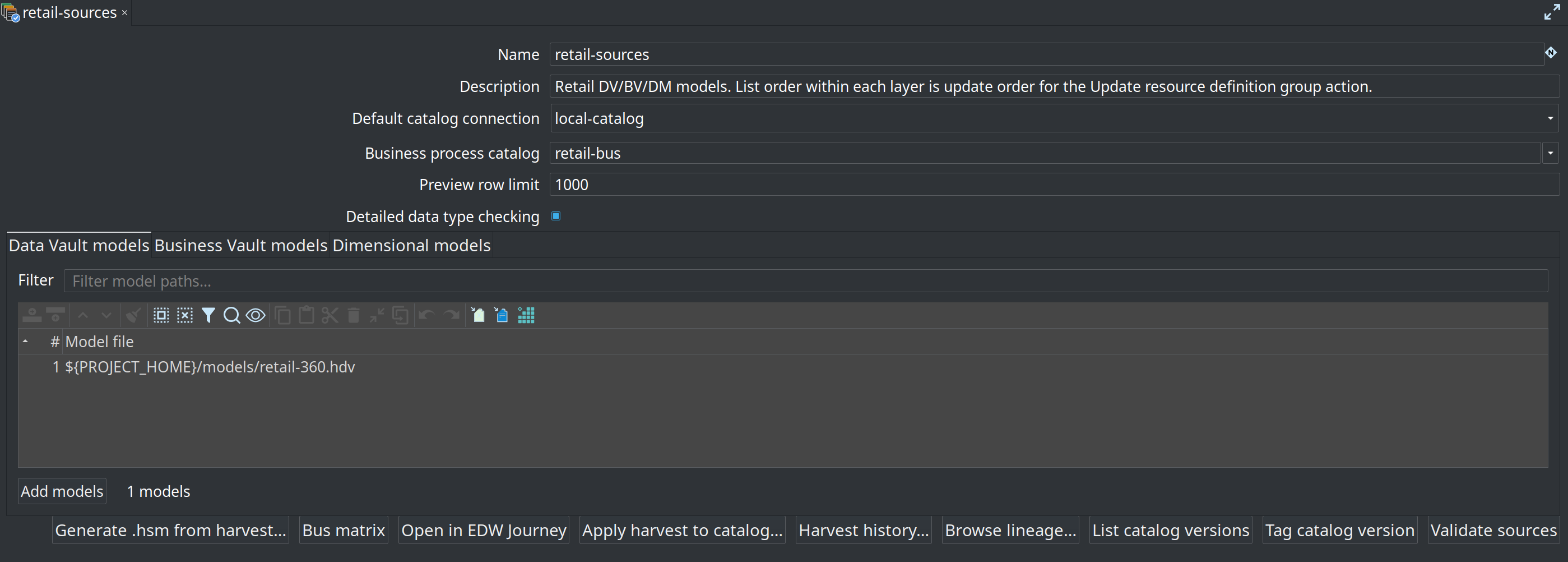
Open metadata type Resource definition group. The bottom button bar includes harvest actions next to version management and validation:
-
Generate .hsm from harvest… / Apply harvest to catalog… — promote harvest inventory (see above)
-
Harvest history… — browse OPS runs and subject drift
-
Browse lineage… — reverse lineage across models in the group
-
List / Tag catalog version, Validate sources — design-time contracts and schema gate
Harvest history browser
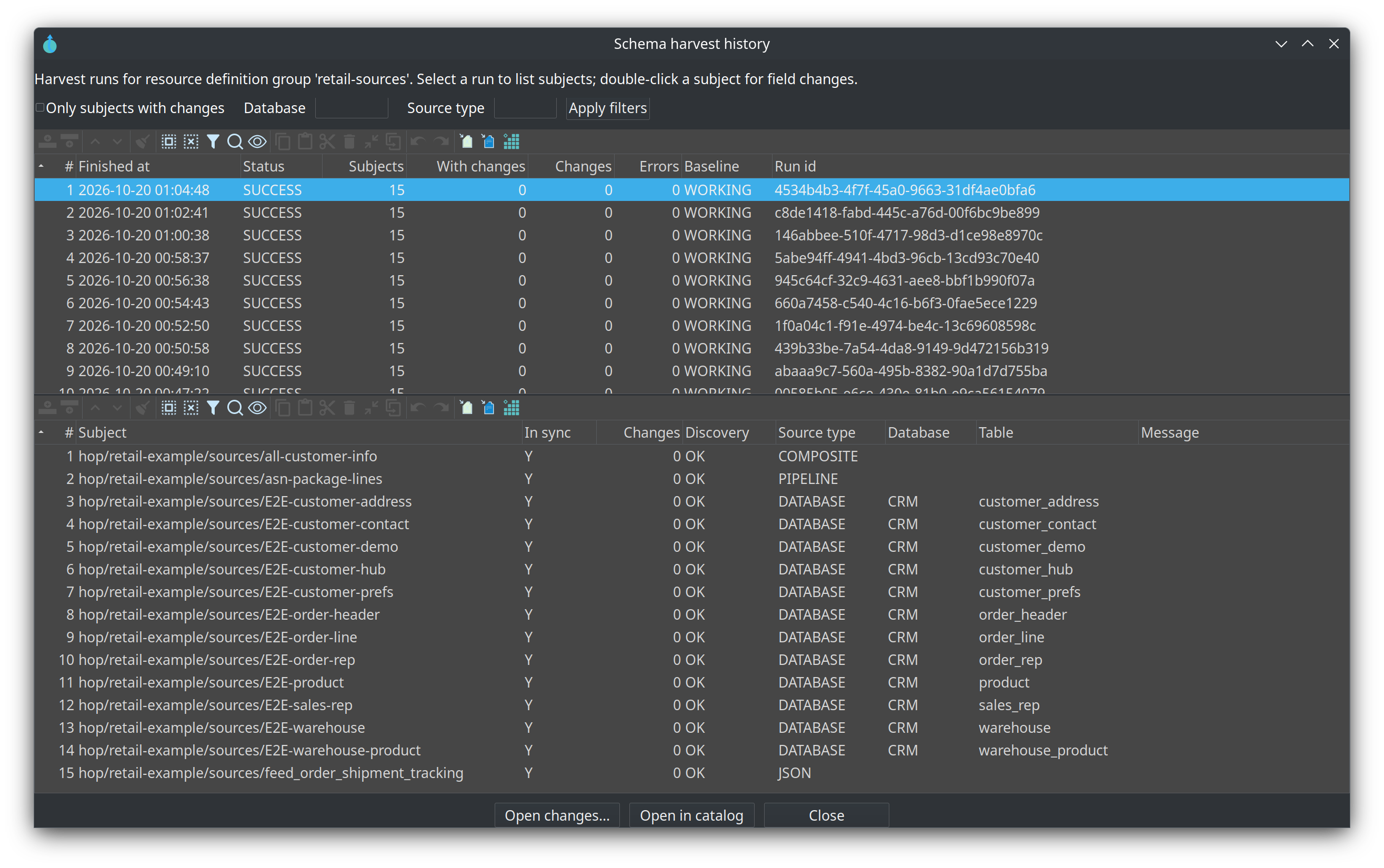
Harvest history… opens a master/detail dialog over OPS schema_harvest_* tables:
-
Master table: recent harvest runs for that group (status, subject counts, change counts, baseline, run id)
-
Detail table: subjects for the selected run (in sync, discovery status, source type, database, table)
-
Filters: Only subjects with changes, Database connection name, Source type (
DATABASE,CSV, …) -
Open changes… / double-click subject → change events + expected/discovered field snapshots
-
Open in catalog → jump to the record definition in the Data Catalog perspective
Subject changes drill-down
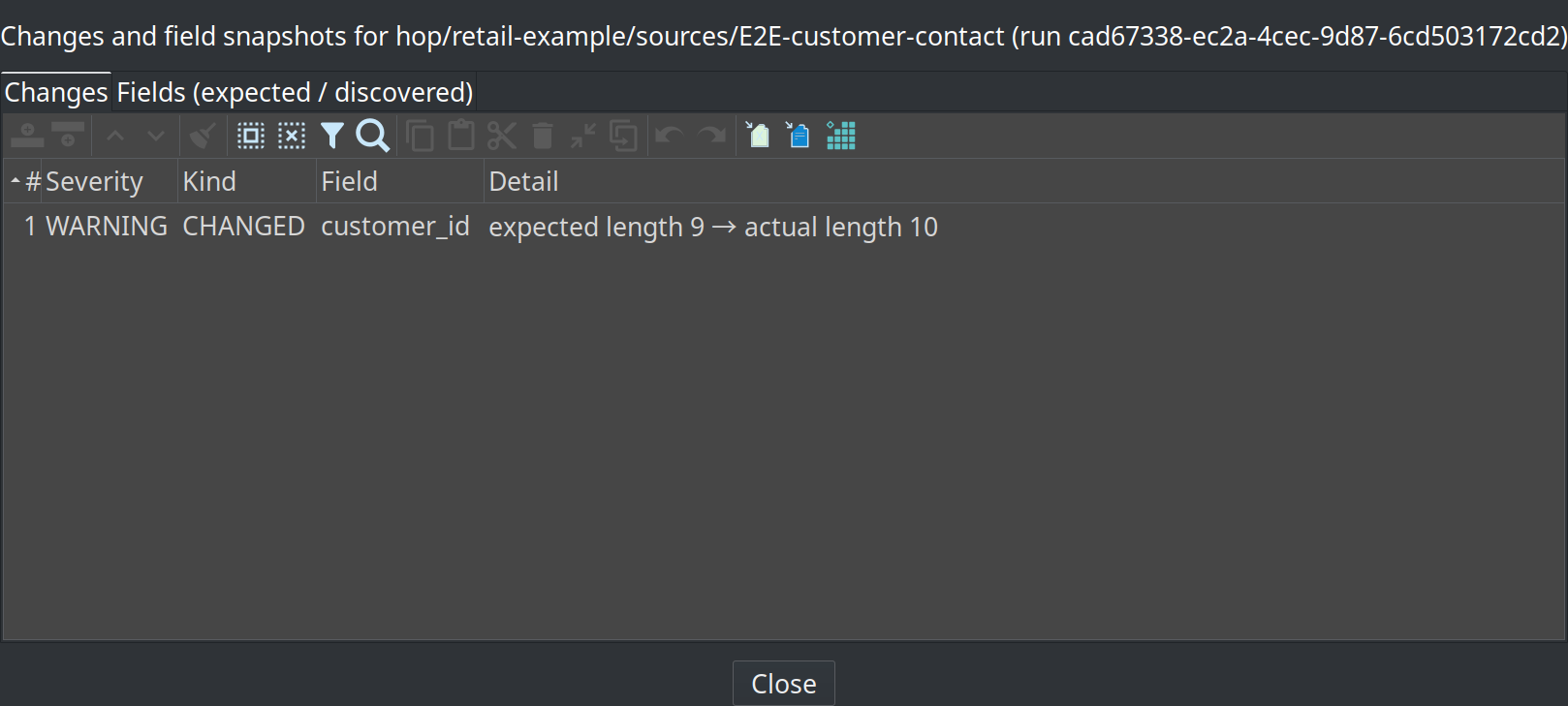
Double-click a subject (or Open changes…) to inspect persisted drift and field snapshots for that harvest run:
-
Changes tab — severity, kind (
CHANGED,ADDED,REMOVED, PK/FK kinds), field, detail -
Fields (expected / discovered) tab — side-by-side snapshots stored in
schema_harvest_field
Catalog record (DV_SOURCE)
On the record detail Quality tab, Schema harvest… opens a timeline of harvest results for that subject key. Double-click a row for the same changes/fields drill-down.
OPS connection resolution matches harvest/gate: SCHEMA_HARVEST_DATABASE, published schema_harvest_run catalog definition, or connection OPS.
Model check reuse (Phase 4)
After harvest (and optionally after the schema gate), Data Vault Update and Update resource definition group can reuse DISCOVERED layouts for detailed type checking:
-
Option Prefer last harvest for type checks (default on)
-
Harvest run id default
${DV_SCHEMA_HARVEST_RUN_ID} -
Harvest history database (OPS) when not auto-resolved
Behavior:
-
Load DISCOVERED fields for each database subject from the harvest.
-
Pre-seed the model-check live-fields cache (same keys as JDBC resolution: connection/schema/table).
-
Cache hits skip live JDBC for those tables; missing keys still discover live.
This avoids a third full source-schema discovery after harvest + gate in the retail chain.
Phase roadmap
-
Phase 1: harvest engine, OPS history, workflow action, reports
-
Phase 2: schema gate
HARVEST_RUN+ retail chain -
Phase 3: harvest history browser (group + catalog subject)
-
Phase 4: model-check reuse of harvest for detailed type checking
-
Follow-on: PK/FK drift inventory, apply harvest → catalog FKs, generate/merge
.hsmfrom harvest (available)
Related documentation
-
Getting started — building an EDW (harvest is day-2, not chapter 1)