Point-in-time (PIT) tables accelerate as-of queries against raw Data Vault hub and satellite history. For each snapshot timestamp and hub grain key, the plugin stores the load timestamp of the satellite row that was effective at that moment.
PIT tables live in the Business Vault (.hbv) model alongside SCD2 tables. They read raw hub and satellite tables on the Data Vault target database and write the PIT table to the Business Vault target database. A source query can replace the satellite (same connection as the Data Vault target); the hub remains a DV alias. Cross-database PIT is not supported because the generated SQL joins hub and satellite in one statement.
What PIT solves
Reporting and marts often need attribute values as they were known at time T (technical as-of). Without a PIT table, every query repeats effective-dating logic: for each hub key, find the latest satellite load timestamp ≤ T, then join back to the satellite.
A PIT table materializes that lookup once:
-
One row per
(hub_hash_key, snapshot_date) -
One pointer column per participating satellite (default suffix
_ldts) holding the load timestamp to join on
Consumers resolve attributes with a simple equi-join:
SELECT pit.snapshot_date, sat.*
FROM pit_customer pit
JOIN sat_customer sat
  ON sat.customer_hk = pit.customer_hk
 AND sat.x_load_ts = pit.sat_customer_ldts
WHERE pit.snapshot_date = :as_of_timestamp
PIT complements SCD2: SCD2 collapses history into functional valid_from / valid_to intervals; PIT preserves technical as-of against raw satellite load timestamps.
Relationship to raw vault and SCD2
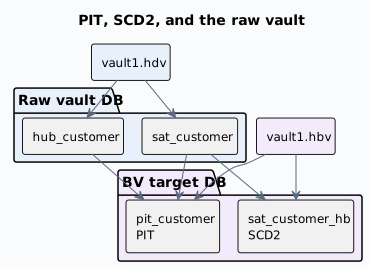
PlantUML source: bv-pit-scd2.puml.
-
PIT reads raw hub/satellite history — not SCD2 output
-
SCD2 and PIT are independent siblings in the same Business Vault Update run (SCD2 tables run first, then PIT)
Target table layout
For each PIT table the plugin creates:
| Column | Source |
|---|---|
Hub hash key |
From the hub derivative (e.g. |
|
Snapshot timestamp on the spine (default column name |
|
Load timestamp pointer for that satellite at the snapshot (suffix configurable, default |
Example: pit_customer with hub hub_customer and satellite sat_customer → customer_hk, snapshot_date, sat_customer_ldts.
Snapshot schedule
Schedule settings are stored inline on BvPitTable (nested BvPitSnapshotSchedule in the .hbv XML).
Cadence and anchor
| Setting | Description |
|---|---|
Cadence |
|
Snapshot anchor |
|
Horizon
|Horizon days|Skips the most recent N calendar days when resolving the spine end date (late-arriving data buffer). Default 1.
When range end is NOW_MINUS_HORIZON, the effective end date is today − horizonDays.
Range start and end
| Range start | Resolves the first snapshot date on the spine |
|---|---|
|
Use |
|
Minimum load date across listed satellite derivatives |
|
Minimum load date on the hub table |
| Range end | Resolves the last snapshot date on the spine |
|---|---|
|
Current date (subject to anchor time-of-day) |
|
Use |
|
Current date minus |
Incremental loads
When the PIT target table already exists, the build pipeline appends only rows where snapshot_date is greater than the watermark from the BV table. At pipeline generation the plugin queries the Business Vault connection for MAX(snapshot_date) (null → sentinel in Java), puts the value in a param_snapshot_watermark Generate Rows transform (limit 1), and binds it into the DV-connected TableInput as a JDBC positional parameter (spine.snapshot_date > ?). That keeps DV and BV databases separated and SQL dialect-neutral. Re-runs are idempotent for dates already loaded.
What gets generated
For each PIT table the plugin builds a Hop pipeline that:
-
Resolves the incremental watermark against the BV PIT table (when present)
-
Resolves snapshot spine bounds from the schedule (and optional MIN load queries on DV tables)
-
Generates daily snapshot timestamps via Postgres
generate_series(end-of-day or start-of-day per anchor) -
Cross-joins hub distinct hash keys with the snapshot spine
-
For each
(hash_key, snapshot_date), selects the latest satellite load timestamp≤ snapshot_date(insert-only satellites) -
Filters to snapshot dates after the resolved watermark (incremental append)
-
Loads the Business Vault target table with
TableOutput(append mode)
The pipeline is a single TableInput (SQL on the Data Vault connection) → TableOutput (on the Business Vault connection).
Use Debug or Show build pipeline on a PIT table in the .hbv editor to inspect the generated SQL before running a workflow.
PIT table dialog (key fields)
| Field | Description |
|---|---|
Name |
Logical name of the PIT table in the |
Physical table name |
Target table in the Business Vault database. |
Derivatives |
Exactly one hub and one or more satellite references. MVP pipeline generation supports one satellite only. |
Snapshot date field |
Output column name for snapshot timestamps (default |
Cadence / anchor / horizon |
Snapshot spine calendar settings (see above). |
Range start / range end |
How the spine bounds are resolved, with optional fixed dates. |
Satellite pointer suffix |
Suffix appended to each satellite table name for pointer columns (default |
Validation
Check model on the .hbv file validates PIT tables:
-
Snapshot date field is non-empty
-
Exactly one hub derivative; at least one satellite derivative
-
Each satellite’s parent hub matches the PIT hub derivative
-
Data Vault and Business Vault target database connections resolve
-
Non-daily cadence → warning (not yet implemented in pipelines)
-
Optional INFO when the hub has satellites not listed on the PIT table
Multi-satellite PIT tables (more than one satellite derivative) fail at pipeline generation in MVP.
Target databases
PIT pipeline generation requires:
-
Data Vault target database — on the linked
.hdvconfiguration (read hub and satellite history) -
Business Vault target database — on the
.hbvconfiguration (write PIT table)
Both connection names must resolve in Hop project metadata. Generated SQL is dialect-aware: PostgreSQL (generate_series), SQL Server, MySQL, SingleStore, and Snowflake (GENERATOR + DATEADD, TIMESTAMP_NTZ).
If you change the linked .hdv file on disk, use Reload DV model on the Business Vault toolbar before generating pipelines.
Single-satellite example (vault1)
integration-tests/tests/basic/vault1.hbv defines:
-
sat_customer_hb— SCD2 fromsat_customer -
pit_customer— PIT fromhub_customer+sat_customer
The PIT table uses a fixed date range (2024-01-31 → 2024-02-01) for deterministic golden tests in CI. Production models typically use EARLIEST_PARTICIPATING_SATELLITE_LOAD and NOW_MINUS_HORIZON.
Workflow: integration-tests/tests/basic/update-vault1.hwf loads the raw vault, runs Business Vault Update (SCD2 then PIT), and validates with validate-pit-customer.hpl against integration-tests/datasets/basic/pit-customer-golden.csv.
Running loads
-
Debug — generate and open the PIT build pipeline in Hop GUI
-
Business Vault Update — model check, optional DDL, generate, stage, and execute build pipelines
PIT tables run after all SCD2 tables in the same Business Vault Update action. See Business Vault Update Action.
MVP limits and roadmap
Current MVP scope:
-
Hub PIT with one satellite derivative
-
Daily cadence only in generated pipelines
-
Insert-only satellites (latest load
≤ snapshot_date; no load-end-date satellites) -
Incremental append by
MAX(snapshot_date) -
Pointer columns:
{satellite_table_name}{suffix}(default_ldts) -
Postgres-oriented SQL in
TableInput
Planned follow-on phases:
-
PIT-2 — weekly/monthly cadence, multi-satellite PIT (one pointer column per sat)
-
PIT-3 — load-end-date satellites, link PIT
-
PIT-4 — range start
EARLIEST_SCD2_TABLE_LOAD, dedicated PIT schedule dialog
Out of scope: raw-vault DvPit in .hdv, auto-PIT for every hub. Business Vault bridge tables are a separate canvas type; see Business Vault bridge.
GitHub issue #26
Issue #26 originally proposed DvPit metadata in the raw Data Vault model (.hdv) and execution via Data Vault Update.
Resolution: PIT is implemented in the Business Vault layer as BvPitTable in .hbv files, with build pipelines and Business Vault Update execution. Raw .hdv models stay focused on ingest; PIT accelerates consumption-layer as-of queries alongside SCD2.
Suggested issue comment when closing or rewriting #26:
Implemented as Business Vault PIT (
BvPitTablein.hbv), not raw-vaultDvPit.
Documentation: business-vault-pit (and business-vault-overview)
MVP: hub + one satellite, daily EOD snapshots, incremental append, Postgres SQL
Sample:
integration-tests/tests/basic/vault1.hbv→pit_customer, validated byupdate-vault1.hwfExecution: Business Vault Update runs SCD2 tables first, then PIT tables
Raw-vault PIT is superseded by this BV approach. Remaining work (weekly/monthly, multi-satellite, link PIT) is tracked in the doc roadmap section.