Data Hopper EDW
Visual, model-driven Data Vault, Business Vault, and dimensional modeling for Apache Hop — with a shared Data Catalog, schema gates, content quality, and explainable source-to-target lineage.
The problem: hand-written vault pipelines drift from the model — hashing rules diverge, satellite CDC is copy-pasted, and hybrid teams (Hop + dbt + SQL) lack one metadata picture. The approach: the visual model is the contract; Hop generates DDL, insert-only loads, SCD2 consumption, and marts from that contract — from source systems through the warehouse.
Explore by topic
Architecture
.hsm → catalog → DV → BV → DM. Resource definition group is the spine.
Data Catalog
DV_SOURCE contracts, COMPOSITE / JSON / PIPELINE feeds, versions.
Source modeler
.hsm tables, Free SQL, pipeline sources, Hop Server JDBC.
Raw Data Vault
Hubs, links, satellites, hybrid modes, composite BKs, aliases.
Business Vault
SCD2 (single & multi-sat), PIT, SQL tables, BV Update.
Dimensional
Kimball dimensions, facts, bridges — Publish & Update.
Schema & harvest
Metadata harvest, CI/CD gates, blast radius, reports.
Data quality
Measure → gate, Phase 2 rules, pre/post load policies.
Lineage
Table/field reasons, OpenLineage / Marquez, reverse browser.
Roadmap
Plans and open GitHub issues grouped by theme.
Architectural overview
Source model (.hsm) publishes contracts into the Data Catalog; a
resource definition group lists the warehouse models and is the spine for harvest,
the schema gate, and Update resource definition group. Full pictures:
docs/architecture.adoc. Build order: docs/getting-started-edw.adoc.
Source model publishes feeds into the catalog. Update resource definition group publishes target layouts out. Harvest observes; it does not rewrite contracts.
Build order
- Configure EDW (catalog + shared configs)
- Source model
.hsm→ Push to catalog - Generate / refine
.hdv→ Check model - Resource definition group (list the
.hdv) - Update resource definition group (DDL + load + publish targets)
- Add
.hbv/.hdmto the same group and update again
Resource definition group
The project’s list of warehouse models plus the default catalog. Harvest, the schema gate, version tags, lineage browse, and the preferred load action all take a group — not a folder of catalog JSON.
Docs: docs/resource-definition-group.adoc, docs/getting-started-edw.adoc
Hybrid integration modes (per table)
Not every raw vault table must be Hop-loaded
| Hop managed | Generate DDL and update pipelines (default). |
|---|---|
| External read-only | Table loaded elsewhere (dbt, SQL, other ETL); Hop documents it for BV and catalog. |
| Custom pipelines | You own .hpl loaders; Hop orchestrates them with generated ones. |
Also on the map
- Execution maps (
.hem) — crawl workflows/models into lineage graphs for GUI and ops. - AI Help — optional LLM advisory with review-before-apply proposals.
- Workflow actions — Data Vault / Business Vault / Dimensional Update, Validate resource definitions, DQ measure & gate.
Feature maturity
What is available today versus planned. Detail pages explain each capability.
| Feature | Status | Detail |
|---|---|---|
Data Catalog + DV_SOURCE (DB / COMPOSITE / JSON / PIPELINE) | Available | Catalog |
Source modeler (.hsm): tables, FKs, queries, JSON, pipeline sources | Available | Source modeler |
| Free SQL over source models (Calcite) + Source model SQL transform | Available | Source modeler · #117 |
Hop Server JDBC (jdbc:hop-hsm:) + thin DBeaver client | Available | Source modeler |
Metadata harvesting + schema gate HARVEST_RUN | Available | Schema & harvest · #112 |
| Resource definition validation (issues, proposals, acknowledgements) | Available | Schema & harvest |
| Catalog version tags + schema impact simulation (CI/CD) | Available | Schema & harvest |
| Data quality measure + quality gate (Phase 2 rules, persist, alerts) | Available | Data quality |
Data Vault modeler (.hdv) + Update action | Available | Raw DV |
| Composite hub BKs · hub aliases · integration modes | Available | Raw DV |
Business Vault modeler (.hbv): SCD2, PIT, SQL views/tables | Available | Business Vault |
Dimensional modeler (.hdm) + Publish / Update | Available | Dimensional |
| Source-to-target lineage, explainable DDL, reverse browser | Available | Lineage |
| Marquez / OpenLineage export | Available | Lineage · #101 |
Execution maps (.hem) · architecture export (Draw.io) | Available | Operations |
| AI Help · project Search Everywhere (Hop 2.19) | Available | Operations |
| Record Definition transforms · Date Dimension Generator | Available | Operations |
| BV naming rules engine | Planned | Roadmap · #41 |
| Automated execution with dependency resolution | Planned | Roadmap · #42 |
.hdm as a masked jdbc:hop-hsm: schema with query audit; lineage cards; crosstab selections and page format; the architecture poster adds Hop JDBC clients.
.hsl) and fact crosstabs; split generated Data Vault files; synthetic data; AdventureWorks sample; bus matrix; Database Workbench previews; presentations, Performance and Gantt charts.
org.hopper:hopper-edw);
generate project documentation; BV SCD2 calculations / SQL Expression, hub business keys,
hash-key partitions; Jinja/dbt import; target type mappings; dialog Help HTML.
.hlv);
first-time architecture / getting-started EDW docs and plugin HTML.
jdbc:hop-hsm: + thin client for DBeaver;
pipeline sources on .hsm; metadata harvesting phases 1–4; richer retail CRM / ASN fixtures.
Data Catalog & sources
Sources live as catalog record definitions — one stable vocabulary from feeds through models to generated pipelines.
What lives in the catalog
DV_SOURCE— logical feeds with record-source indicator, optional group for partial loads, and physical layout: database table, COMPOSITE (multi-table query), JSON, or PIPELINE.- Namespace pattern:
hop/{project}/sources(e.g.hop/retail-example/sources). - FILE catalog storage (retail:
work/edw-catalog/) opened in the Hop Data Catalog perspective. - Hubs, links, and satellites reference source names, not raw connection strings.
- Go to origin opens the
.hsmcard for published composite / JSON / pipeline feeds.
Published namespaces
hop/{project}/models/{model}/— DV table layoutshop/{project}/business-vault/{model}/— BV targetshop/{project}/dimensional/{model}/— mart tableshop/{project}/lineage/{dv|bv|dm}/{model}/— lineage siblings (derived, not edited)hop/{project}/operations/— load metrics, harvest, quality ops stubs
Catalog versions & transforms
- Tag catalog version freezes source contracts (e.g.
v1.0.0). - Baselines for the CI/CD schema gate (live source, working vs tag, version vs version, harvest run).
- Resource definition group is the spine: model lists + default catalog; harvest, schema gate, versions, and Update RDG all take a group.
- Pipeline transforms: Record Definition Input / Output / Data Input.
Source modeler (.hsm)
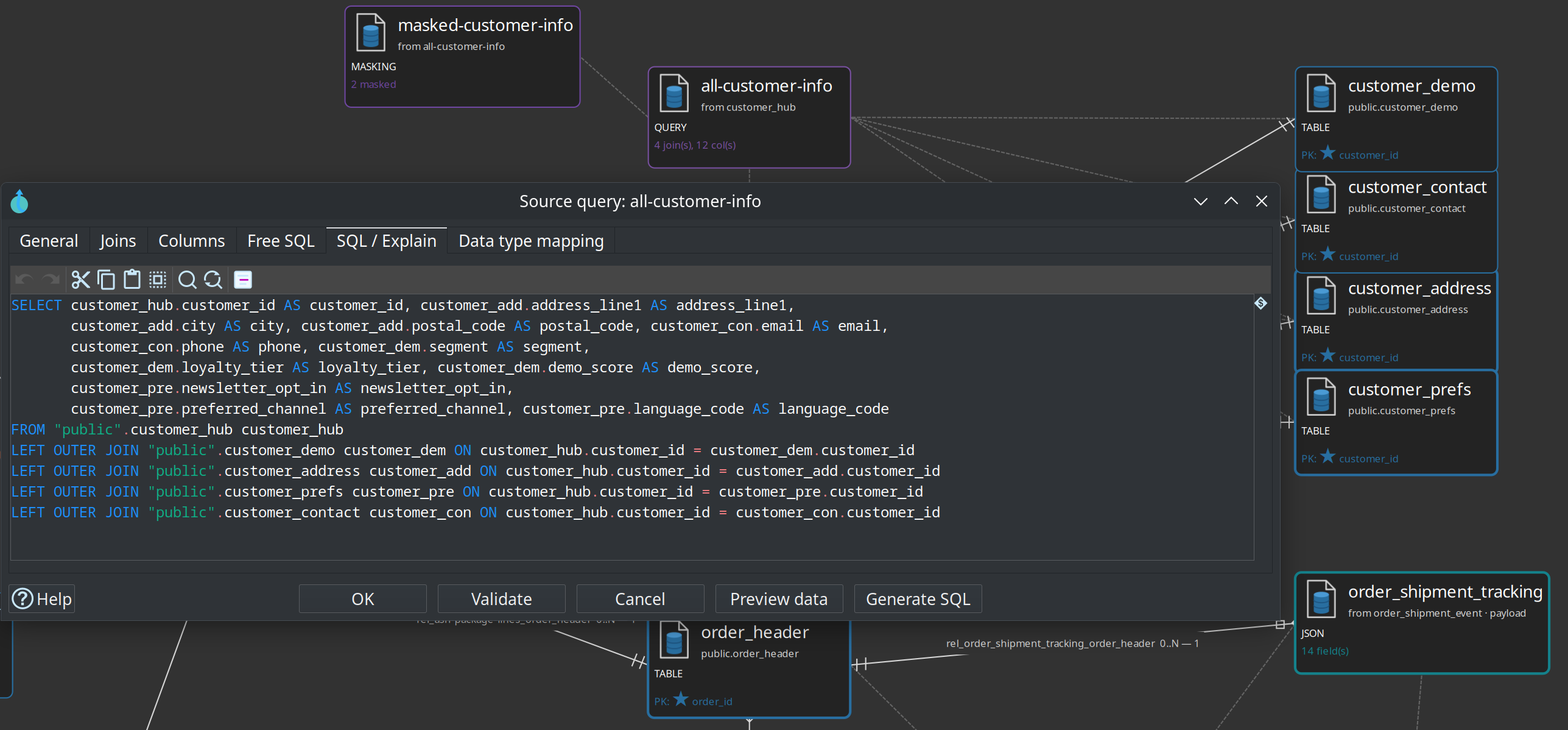
Visual model of source systems: tables, relationships, multi-table queries, JSON extractions, pipeline contracts — and free SQL virtualisation over the whole model.
Tables & FKs
Import database tables with PK/FK discovery, crow’s-foot relationships, and live schema checks.
Source queries
Join builder + projection, or Free SQL (Calcite) with explain plan, preview, and publish as COMPOSITE.
JSON & pipelines
Flatten parent JSON fields; declare .hpl + output transform + fields; publish as JSON / PIPELINE.
Free SQL & data virtualisation (#117)
- Apache Calcite parses SQL against the source model schema (tables, named queries, JSON, pipeline feeds).
- Full pushdown — single Table Input when all tables are DATABASE on one connection.
- Residual path — Sort + Merge Join, Filter, Group By, Calculator, MetaInject / JSON subgraphs when mixed.
- Source model SQL pipeline transform for runtime free SQL against a
.hsm. - Source model service metadata maps a public name to a server-side
.hsmpath. - Hop Server servlet
/hop/sourceModelData+ thin client jarhop-hsm-jdbcfor DBeaver:jdbc:hop-hsm://{username}:{password}@{host}:{port}/{database}({database}= service name = JDBC schema).
Publish & load
- Queries → catalog
COMPOSITE - JSON → catalog
JSON(parent + JsonInput loads) - Pipelines → catalog
PIPELINE(MetaInject + record source) - DV Update injects generated graphs with hub sort/distinct when needed
Retail sample
retail-example/models/source-tables-crm.hsm- Multi-table customer query, shipment JSON, ASN pipeline feed
- Service metadata:
metadata/source-model-service/crm.json
Data Vault modeler (.hdv)
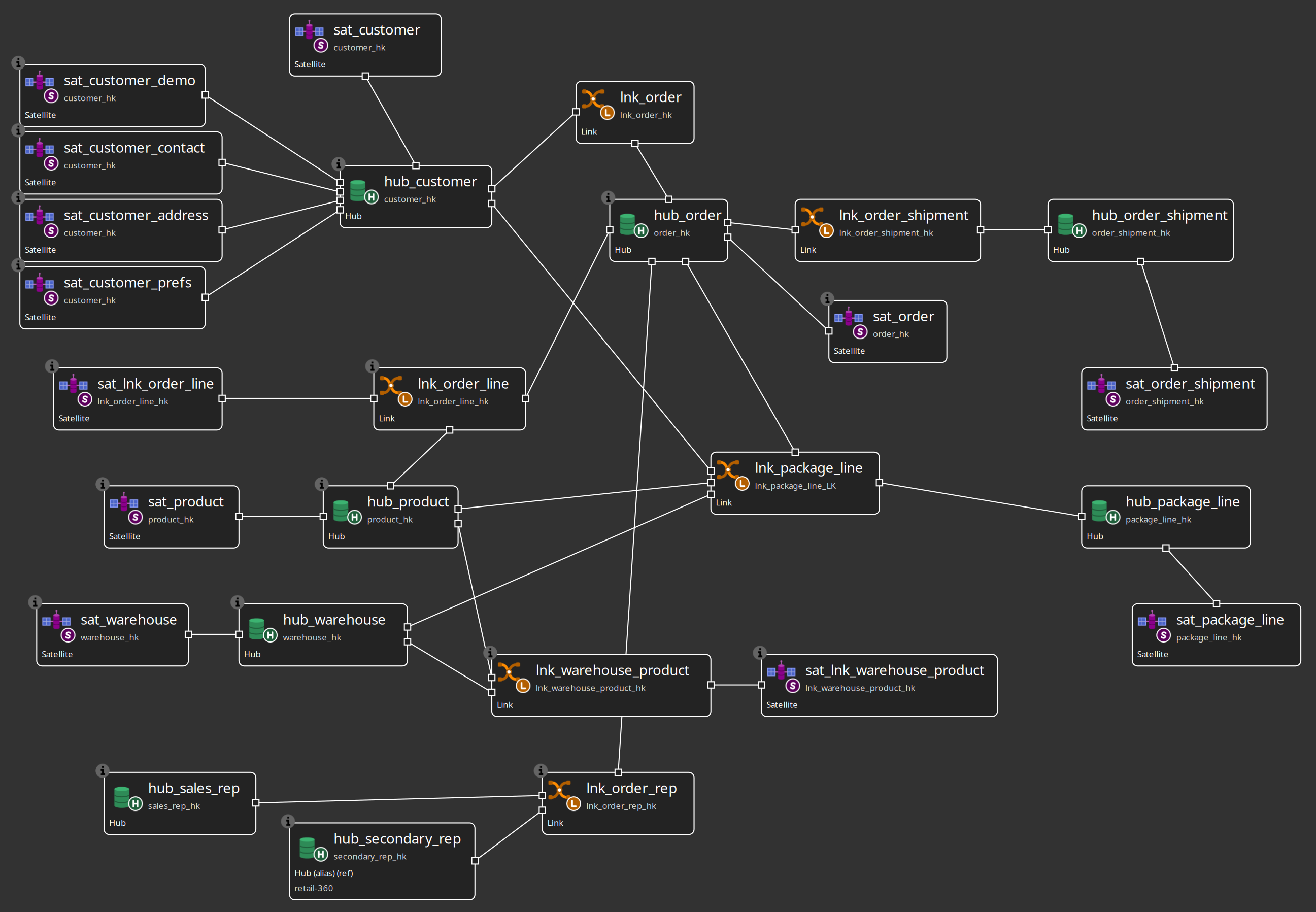
Visual hubs, links, and satellites with embedded configuration. The model drives DDL and insert-only load pipelines.
Hubs
Core business entities with multi-source business keys; composite BKs (multi-field → one vault column).
Links
Relationships between hubs; transactional links with dependent child keys; hub aliases (same hub twice).
Satellites
Descriptive history — hashdiff or load-end-date patterns; multi-active via driving keys; JSON/pipeline sources.
Operations on the model
Data Vault Update action
- Validates (optionally), generates DDL, stages update pipelines
- Runs loads in parallel with a shared load timestamp
- Supports record source groups for partial model updates
- Fail-if-DDL and explainable structure changes (via lineage)
DV 2.0 options
- Hashing: MD5 / SHA1 / SHA256 / SHA512
- HEX, String, or Binary hash keys
- Trim + casing, delimiter, null placeholder
- Unknown / invalid sentinel records
- Standard column naming (load TS, record source)
docs/images/)Business Vault (.hbv)
Raw vault stores technical history. Business Vault delivers functional timelines — when the source said a value was true.
Table types
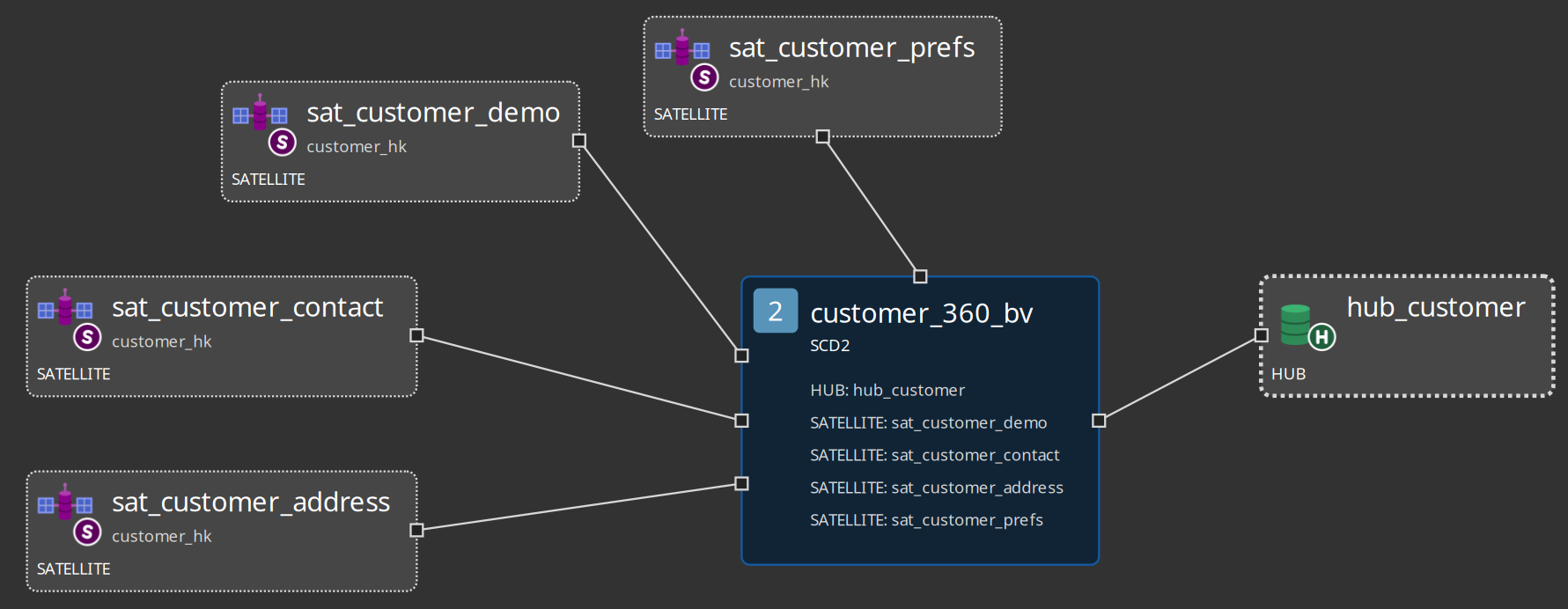
SCD Type 2
valid_from/valid_to(configurable names)- Open-ended current rows
- Single-satellite or multi-satellite merge (e.g. Customer 360)
- Incremental load support with separate DV/BV databases
PIT & SQL
- PIT helpers for point-in-time joins across satellites
- SQL business tables — view or table materialization
ref()/sourcehelpers; BV→BV canvas references- Catalog model registry for short lookups
Dimensional modeler (.hdm)
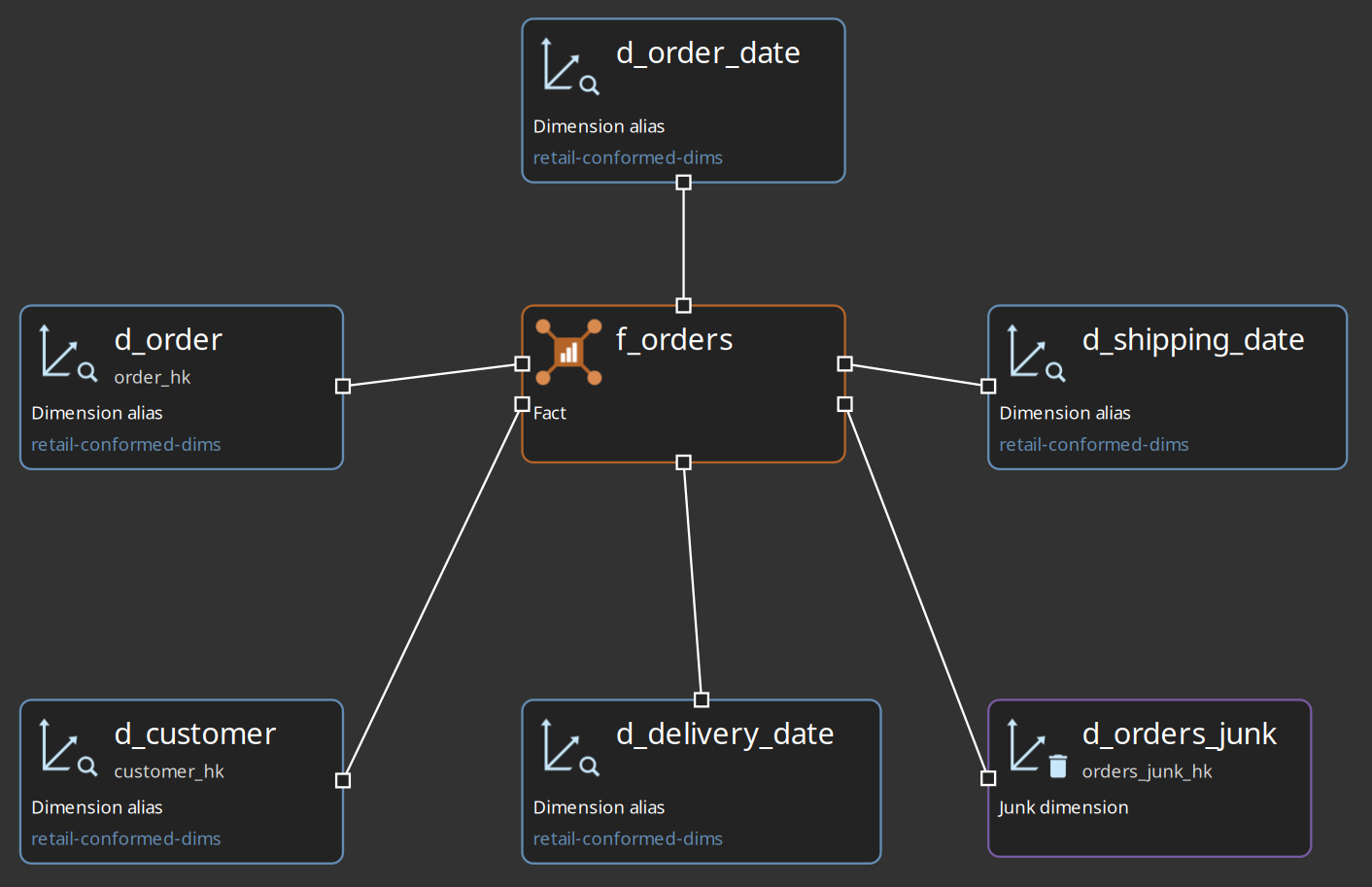
Kimball star/snowflake modeling on the same canvas patterns as the vault modelers — driven by metadata, loaded by workflow actions.
Dimensions
Conformed, role-playing, junk, range dimensions.
Facts
Transactional, snapshot, and aggregate facts.
Bridges
Many-to-many relationship structures.
Date dimension
Date Dimension Generator transform for calendar attributes.
Dimensional Publish
Draft a .hdm model from a .hdv vault as a starting point for the mart design.
Dimensional Update
Load the mart from the model — same validation-before-execution philosophy as DV/BV updates.
Schema gates & metadata harvest
Catch broken references and contract drift before production loads — in the GUI and as a CI/CD gate.
Check model
- Same engine in GUI toolbar and update actions
- Structural rules + optional live source type checking
- Stops broken references before pipeline generation
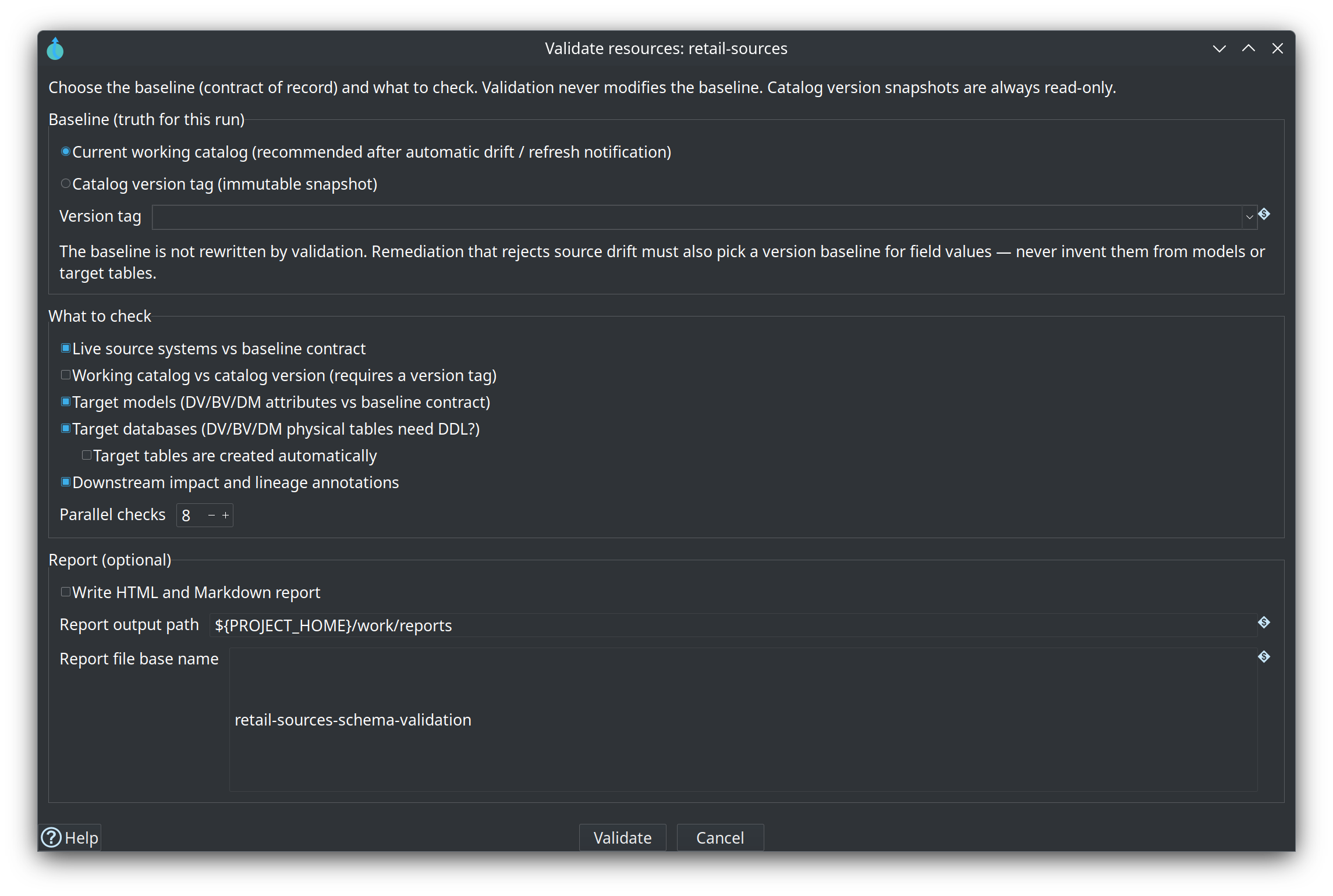
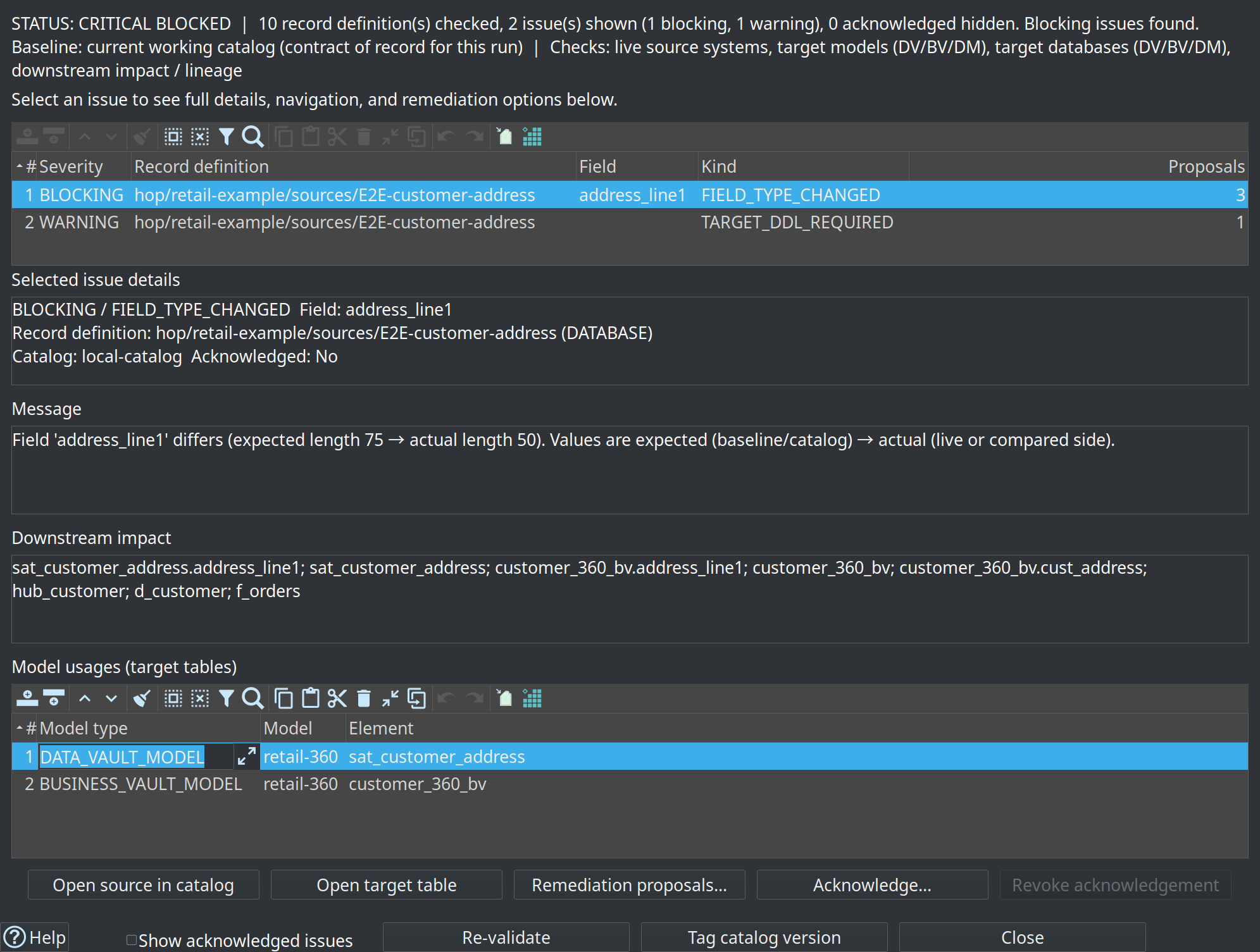
Resource definition validation
- Feed-level checks with remediation proposals
- Acknowledgements for accepted exceptions
- Downstream impact Source→DV→BV→DM
- Design-time options: baseline + axes before each run
Metadata harvesting (phases 1–4)
- Harvest source metadata action — connection-batched live discovery, OPS history (
schema_harvest_*) - Does not rewrite the catalog; observation is separate from load
- Schema gate mode
HARVEST_RUNreuses a harvest without rediscovery - History browser, PK/FK drift, apply FKs → catalog / generate
.hsm, model-check prefers harvest for types
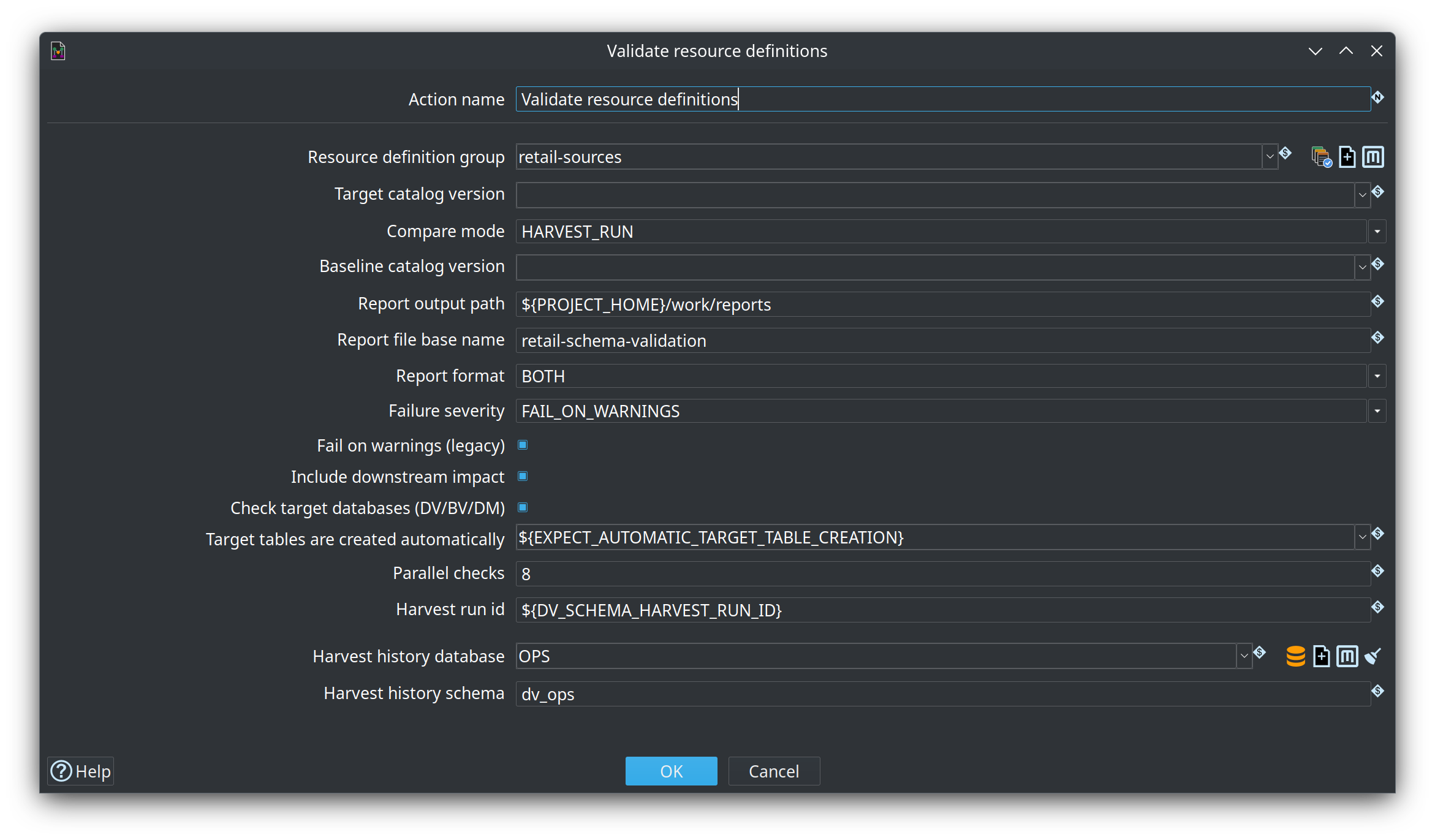
Validate resource definitions — CI/CD schema gate
- Compare modes: live source · working vs tag · version vs version · HARVEST_RUN
- Failure severity:
FAIL_ON_BLOCKING,FAIL_ON_WARNINGS,WARN_ONLY - Reports: Markdown and/or HTML with blast-radius tables (e.g. under
work/reports/) - Place the action before DV/BV/DM update actions in workflows
Catalog-safe length remediation
- Working catalog field length is the contract — length expand does not rewrite the catalog
- Expands DV satellite, BV SCD2 maps, and DM SQL-sourced columns (multi-table SQL + workflow)
- Retail sample:
workflows/schema-remediation/accept-address_line1/(address_line1→ 75 on sat / BV /d_customer)
Data quality measure & gate
Schema contracts are not enough. Measure content rules against sources and published targets, then apply policy.
Measure Data Quality
Run rules against catalog subjects; produce a report; optionally persist history. Does not fail the workflow on findings (only infrastructure errors).
Evaluate Quality Gate
Apply policy to a report; optional alert sinks. Can fail the workflow (FAIL_ON_BLOCKING / FAIL_ON_WARNINGS) or alert only.
Typical patterns
Rule library (Phase 1 + 2)
Phase 1: min/max row count, NOT NULL, allowed values, range, not-empty string.
Phase 2: null ratio max, min/max distinct, regex, min/max length, SQL assertion (trusted authors; single SELECT).
Source-to-target lineage
Which feed contributes to a target? How is each column derived? Why does that mapping exist? Models remain the source of truth — lineage is a deterministic projection.
Capabilities
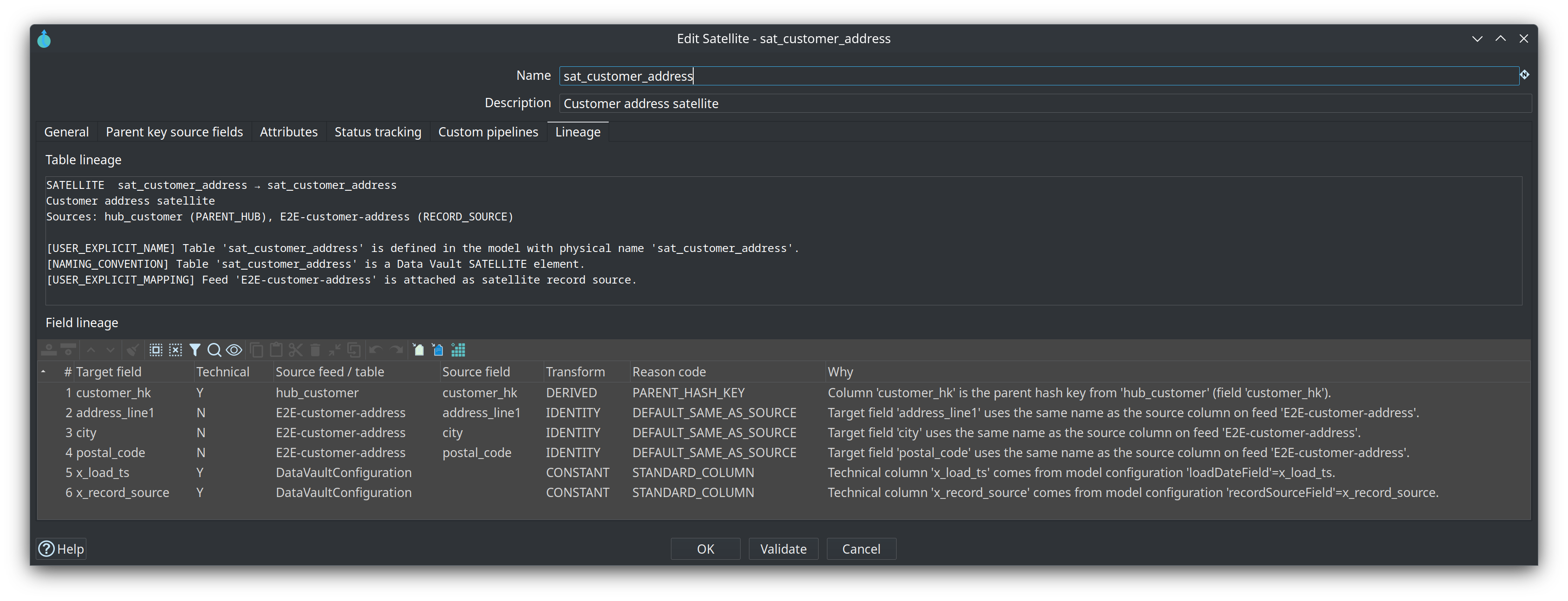
- Table + field lineage for DV, BV, and DM with structured reason codes
- Lineage tab on hub, link, satellite, BV SCD2, and dimensional table dialogs
- Explainable DDL — every structure change is explained via lineage edges (not a boolean only)
- Catalog publish — sibling records under
hop/{project}/lineage/… - Drift gate — Validate resource definitions compares models to catalog lineage baselines
- Reverse browser — from source field to all DV/BV/DM consumers (Resource definition group → Browse lineage…)
- OpenLineage / Marquez export (0.5.0) — workflow action Export data lineage: folder and/or HTTP POST, column lineage, physical location facets, dimension-alias symlinks
Selected reason codes
| Code | Meaning |
|---|---|
USER_EXPLICIT_MAPPING | Explicit source field mapping (e.g. hub business key) |
DEFAULT_SAME_AS_SOURCE | Target column uses the same name as the source |
STANDARD_COLUMN | Config-driven technical column (load TS, record source, …) |
HASH_FROM_BUSINESS_KEYS | Hash key derived from business keys |
LINK_HUB_KEY_MAPPING | Link maps source columns to participating hub keys |
BV_SCD2_FIELD_MAP | Explicit Business Vault SCD2 field mapping |
DM_ROLE_MAPPING | Dimensional role, measure, or staging mapping |
Operations, execution maps & AI
Workflow-driven batches, observable loads, optional AI advisory — modelers stay in control.
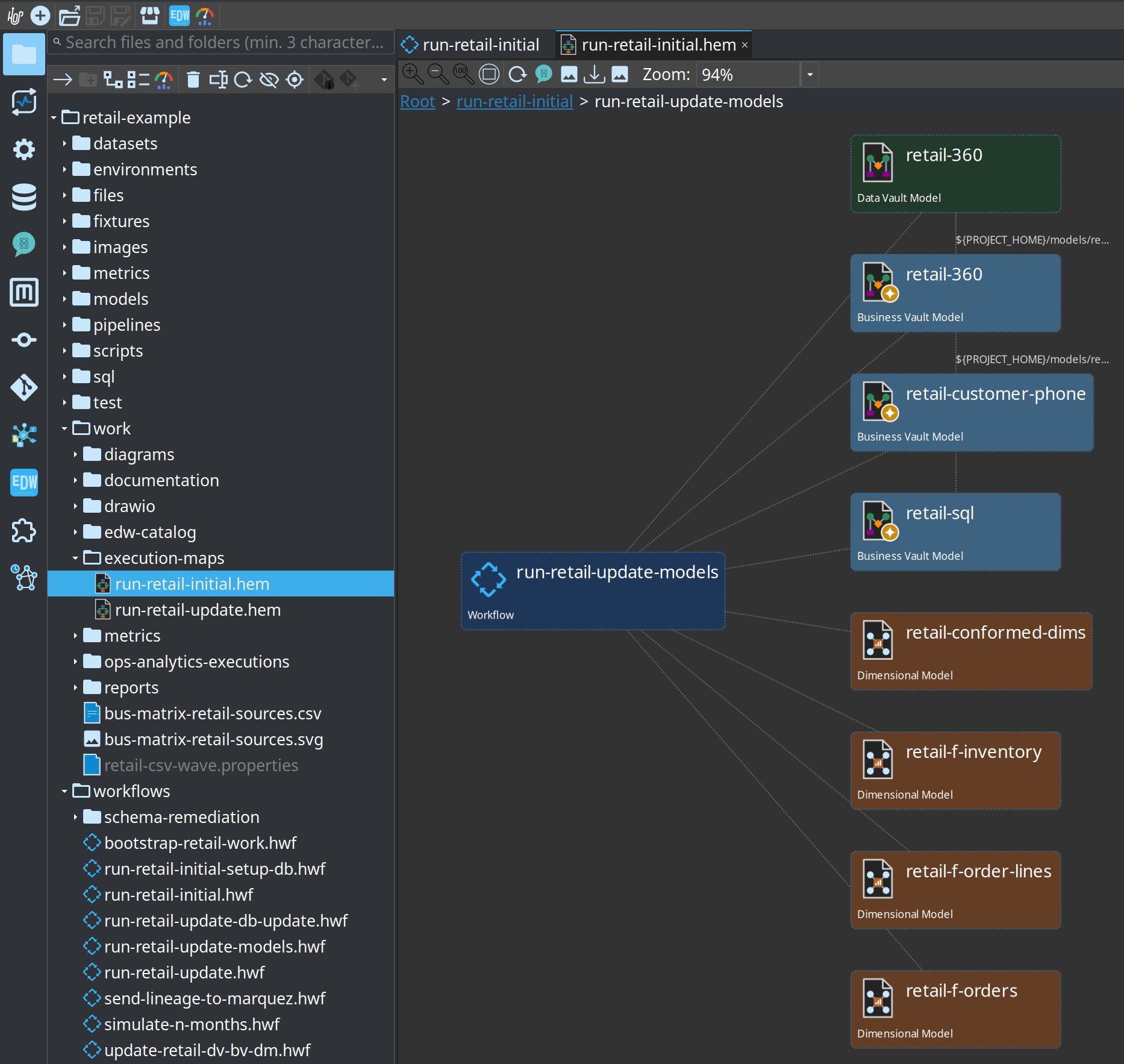
Execution maps (.hem)
- Crawl a root workflow or model
- Persist a graph of workflows, models, generated pipelines, source datasets
- Open in Hop GUI for execution and lineage-oriented views
Runtime operations
- Docker runners:
scripts/run-hop.sh,run-postgres.sh - Parallel pipeline orchestration
- Record source groups for partial loads
- Catalog-backed load-run metrics; workflow load overview; per-table duration bars
Pipeline transforms & tooling
- Record Definition Input / Output / Data Input — catalog definitions and field layouts as rows
- Source model SQL — free SQL against a
.hsmat runtime - Date Dimension Generator — populate standard calendar dimension attributes
- Architecture export — Draw.io SOLUTION / inventory / DV·BV·DM diagrams
- Search Everywhere — Hop 2.19 project search for models and plugin metadata
hop svg— export pipelines, workflows, and models to SVG
AI Help (optional)
LLM advisory on Data Vault models, pipelines, and workflows — scenarios, context inclusions, review-before-apply proposals.
- Suggest hubs, links, satellites from catalog sources
- Layout and type mapping proposals
- Performance tuning scenario using load-run metrics (parallel copies, preload cache)
Configure under Hop GUI → Configuration → AI Assistant. Human modelers remain in control.
Sample projects
Two Hop projects ship with the plugin — a tutorial path and a CI regression suite.
retail-example
Learning path — CSV → CRM → DV → BV → DM, initial and monthly updates.
- Register as Hop project
retail-example - Source model
source-tables-crm.hsm(queries, JSON, pipeline feeds) workflows/run-retail-initial.hwfthen monthlyrun-retail-update.hwf- Quality gates pre/post load; optional harvest + schema remediation samples
- Primary onboarding:
docs/getting-started-retail.adoc
integration-tests
CI / regression — Customer 360, multi-active, external read-only, golden datasets.
- Register as Hop project
hopper-edw - PostgreSQL, MySQL, SingleStore, SQL Server runners
./run-tests.shor multi-DB Docker matrix
Featured fixtures
- vault1 — classic hub / link / satellite
- customer-phone — multi-active satellite
- customer-360 — four satellites merged into one BV SCD2 table
- customer-360-external — same BV with external read-only DV satellites
- retail CRM HSM — Free SQL, shipment JSON, ASN pipeline, source-model-service
crm
Video tutorials
Planned functionality & open issues
From design plans in docs/plans/ and GitHub issues on
ProjectDataHopper/hopper-edw
(snapshot as of 2026-08-10). Pre-1.0 software — capabilities can still evolve.
Recently shipped
Free SQL / source-model virtualisation
Calcite free SQL, Source model SQL transform, Hop Server servlet + thin hop-hsm-jdbc client for DBeaver.
Metadata harvesting
Harvest action, OPS history, HARVEST_RUN gate mode, history browser, FK apply / HSM generate.
Pipeline sources on source modeler
Declare .hpl + output fields; catalog PIPELINE; MetaInject loads with record source.
Marquez / OpenLineage export
Export data lineage action (folder + HTTP), physical location facets, dimension-alias symlinks.
Hub aliases · Draw.io export · Search · RDG update
Same hub twice on a link; architecture export; Hop 2.19 project search; Update resource definition group action.
Named plans Planned
BV naming rules engine
Configurable naming conventions for Business Vault tables and columns.
Coach panel · AI M2 · metrics extensions
In-modeler coaching UI, deeper AI assistant milestones, load-run metrics evolution.
Platform & automation
Automated execution with dependency resolution
Hand over DV/BV/DM models; resolve update order, parallel tracks, per resource group, skip already-updated windows.
Automated DDL regression testing / DDL guard
Compare generated DDL to deployed schema; halt on destructive changes until human approval.
Downstream impact dry-run on field changes
When updating catalog source fields, simulate Source→DV→BV→DM consequences before apply.
Lineage & observability
Visual lineage with live metrics
Overlay runtime telemetry on hubs/satellites (e.g. “42 min today vs 2 min average”).
Time-travel auditing & as-of validation
Automated as-of reconciliation: sample historical source vs vault PIT query and diff.
Modeling enhancements
Date dimension enhancements
Custom SQL attributes, relative attributes (YTD, M−1, …) driven by a business reference date.
dbt-style macros in SQL Business Vault tables
Register macros in Hop metadata; path toward dbt-core interoperability.
Ghost records & early-arriving facts
Built-in orphan prevention, quarantine / error satellite, auto placeholder hubs.
UX, docs & follow-ups
Validation issues UX
Clearer path from found issues to details/proposals (beyond double-click).
Automatic model documentation generator
Generate table docs, descriptions, and source-to-target mappings from models.
PK / constraints in generated DDL
Shipped in 0.5.0: optional primary and foreign keys on DV/BV/DM model DDL (default off).
Summary
The Data Hopper EDW turns Data Vault 2.0 from a pile of pipelines into a governed, model-driven platform.
Model the warehouse. Let Hop generate the mechanics.
Source systems from .hsm · Raw vault from .hdv · Business vault from .hbv ·
Dimensional marts from .hdm · Catalog, harvest, validation, quality · Free SQL / JDBC over sources ·
Lineage that explains every mapping.
Who benefits
| Architects | Governed hashing, hybrid warehouses, schema gates, harvest history, lineage drift detection. |
|---|---|
| Modelers | Visual design from source to mart, Free SQL, generated pipelines, BV without hand-written SCD2 SQL. |
| Operations | Workflow batches, CI/CD gates, quality pre/post load, execution maps, parallel orchestration. |
| Analytics / BI | SCD2 timelines, dimensional marts; optional DBeaver access via jdbc:hop-hsm: to source models. |
Get started
- Install plugin 0.16.0 into Apache Hop 2.20.0-SNAPSHOT
- Walk
retail-example/withdocs/getting-started-retail.adoc - Deep fixtures:
integration-tests/ - Feature list:
docs/feature-overview.adoc